

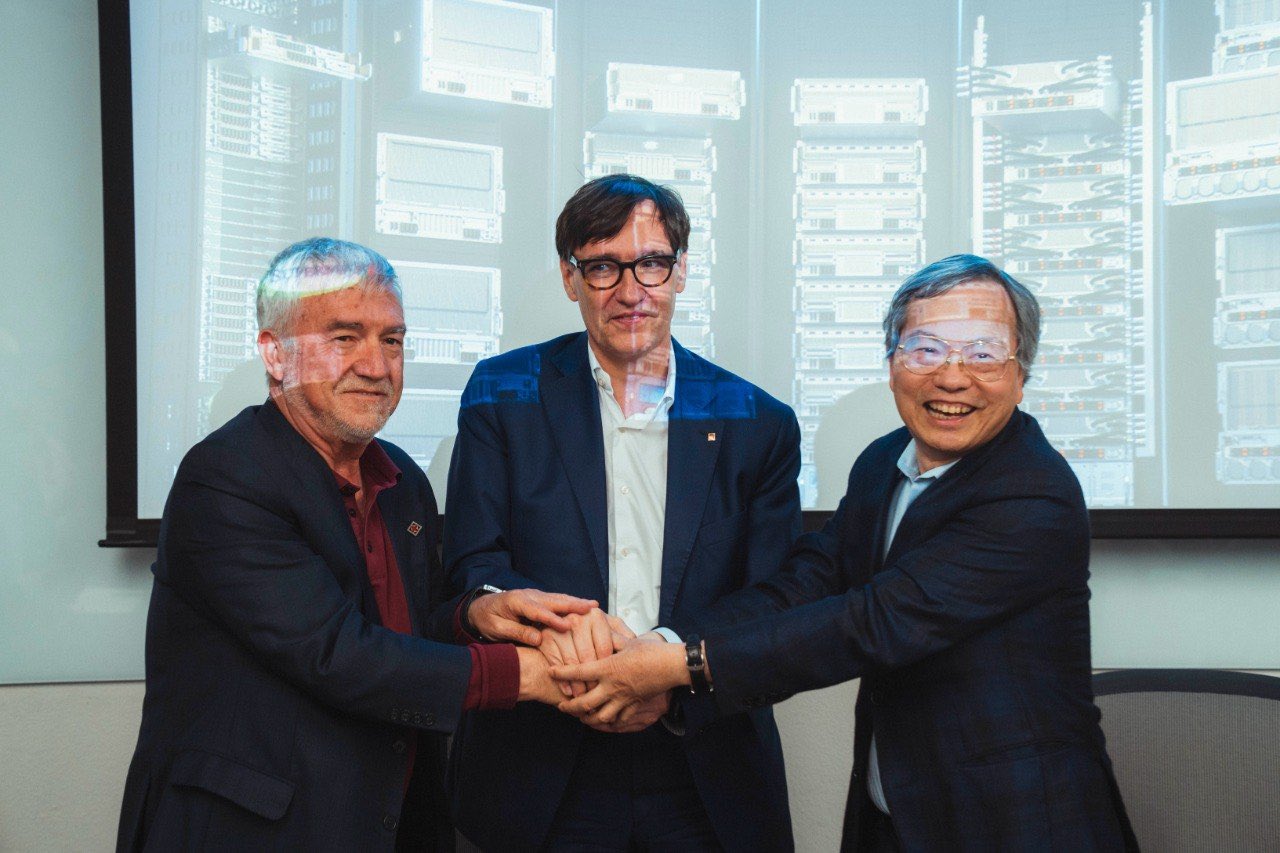


Catalonia is stepping up its efforts to position itself as a major European hub for artificial intelligence (AI) and technological innovation following a high-level institutional visit to California aimed at deepening ties with Silicon Valley’s leading companies and research institutions.
Catalonian government President Salvador Illa met with executives from major technology firms during his delegation visit from May 13 to 17, 2026 – including Google, OpenAI, NVIDIA, Microsoft, Apple and Meta representatives – as well as with research centers and universities.
The trip was designed to strengthen collaboration in AI, research, and investment, framed in the context of Catalonia’s ongoing expansion of its international footprint in emerging technologies.
The visit, however, highlights Catalonia’s broader ambition to position itself at the centre of Europe’s AI and innovation ecosystem at a time when governments across the region are seeking to strengthen technological capacity while remaining deeply integrated with U.S.-based tech infrastructure.
At the core of the visit was the question of how Catalonia can scale its role in AI, supercomputing, and digital innovation while competing in a global landscape dominated by American and Chinese firms.
Officials framed the trip as a way of building long term partnerships that would support both scientific development and economic growth, with President Illa saying: “We come to open ourselves to the world so that the world comes to invest in Catalonia.”
The push for sovereign European AI
During meetings with Catalan executives working in Silicon Valley, Illa described his government as pro-technology and pro-science, focused on placing innovation at the service of public good – reflecting a wider strategy to attract investment and talent while positioning the region as a bridge between European policy frameworks and global tech ecosystems.
A central part of the delegation’s agenda was the Barcelona Supercomputing Center, one of Europe’s leading research institutions in high-performance computing. The centre signed new agreements with NVIDIA and Supermicro aimed at advancing Europe’s capacity in AI and computing infrastructure in April and May, respectively.
These partnerships are linked to the development of MareNostrum 6, the next generation of Catalonia’s flagship supercomputer project. The initiative is frequently framed within the broader European push for sovereign AI, an effort to reduce reliance on external technology providers, and strengthen domestic capabilities in critical digital infrastructure.
However, the reliance on partnerships with major U.S. companies highlights a tension at the heart of Europe’s AI strategy: while policymakers increasingly talk about technological sovereignty, many of the most advanced systems and AI models continue to be developed and controlled by American firms.
Europe’s dependence on American tech
This contradiction is becoming increasingly visible across Europe. Governments want to build independent digital capacity, but they also depend heavily on companies such as NVIDIA for hardware, Microsoft for cloud infrastructure and OpenAI and Google for frontier AI systems. Catalonia’s approach reflects this reality rather than resolving it.
The challenge is not only geopolitical but also structural. According to a report by Ness Digital Engineering, only about 20% of European Union enterprises were actively using AI in 2025, despite the technology being considered a top strategic priority. The report argues that overcoming these limitations will require a transition toward “AI-ready” data platforms, which represent a fundamentally different approach to data architecture rather than incremental upgrades to legacy systems.
Alongside the AI and supercomputing agenda, the delegation also promoted the Catalunya Media City project in Hollywood, which aims to strengthen the Spanish autonomous community’s position in audiovisual production and digital content, expanding its role beyond traditional technology sectors.
The visit also included collaboration discussions with Stanford University focused on digital health and biodesign innovation. One long-running partnership highlighted during the trip connects Catalan institutions with Stanford’s Mussallem Center for Biodesign, and involves joint work on medical technology and healthcare innovation.
Barcelona’s wider innovation ambitions
Catalonia’s government has maintained a presence in Silicon Valley for more than a decade through its trade and investment office in the San Francisco Bay Area.
The office is designed to connect Catalan startups and research institutions with U.S.-based investors, companies and academic networks, while also supporting foreign firms interested in establishing operations in Catalonia.
This long-term strategy demonstrates Barcelona’s wider ambition to establish itself as one of southern Europe’s leading startup ecosystems. The region has increasingly marketed itself as a destination for technology investment, research partnerships and talent attraction, particularly in fields such as AI, digital health and semiconductors.
Despite these ambitions, Catalonia’s strategy also reflects a broader European challenge: as AI development accelerates globally, Europe continues to debate how to strengthen its own technological sovereignty without losing access to the companies and infrastructure that currently dominate the sector.
For Catalonia, the challenge will be whether it can convert international partnerships into genuine technological leadership within Europe – or whether it remains primarily a regional node within a system still shaped by U.S.-based technology giants.
As Europe enters a new phase of competition over AI, Catalonia’s push into Silicon Valley illustrates both the opportunity and the constraint facing many European regions. The ambition is clear, but the balance between collaboration and dependence remains unresolved.
Featured image: Salvador Illia Roca via X.